


Happy Friday, January 30th. So close!
WELCOME :)
Just a reminder: every Tuesday and Friday, I’ll be in your inbox with the latest in politics, tech & social media, culture, and other relevant topics – and I’ll share some notes and tips on what I’m keeping my eye on.
Want to do a super fun, super cool rapid interview for this newsletter like the one below??? Reply to this email or hit the button below. Tips, thoughts, concerns, good jokes, bad jokes, ☕️, etc?
And finally, if you enjoy this newsletter and want to share it with your network (and/or your chronically online friends), or buy me a matcha, that would be so appreciated 🙏

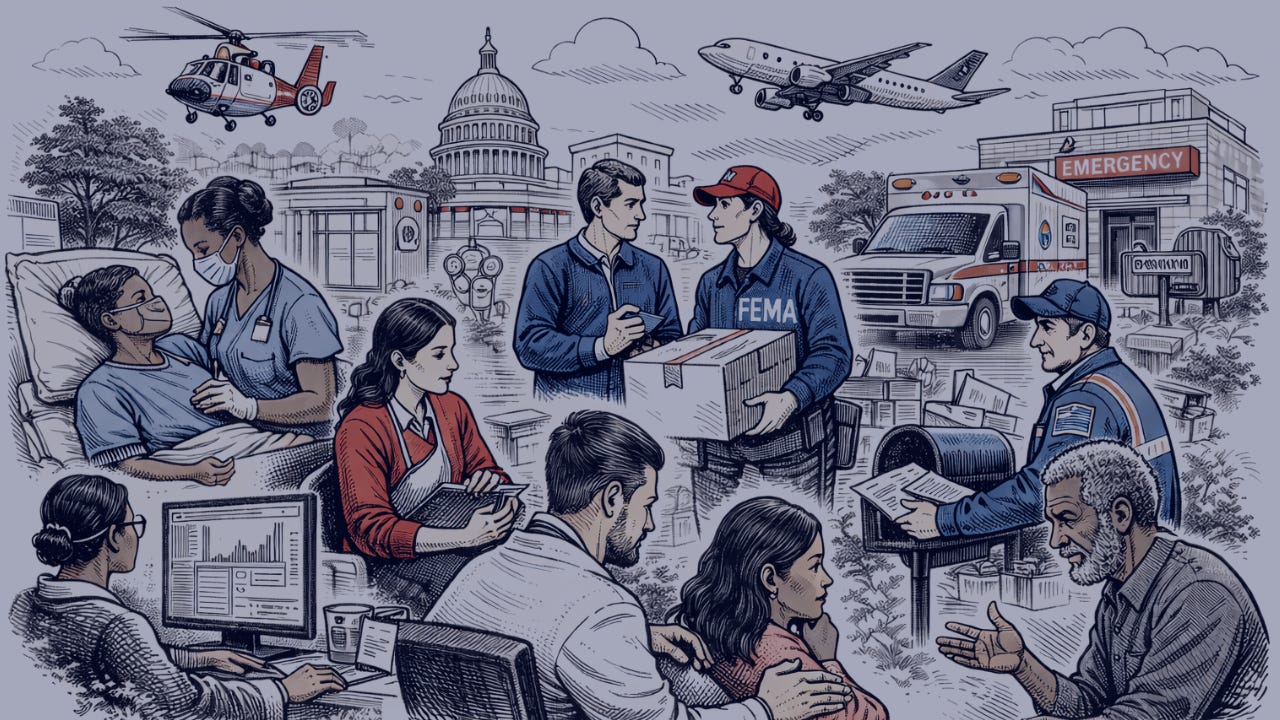
Today, we have some texts from Dr. Scott Green, who is a licensed psychologist and the CEO and co-founder of The G2 Group, which works with federal, state, and local governments, in addition to other groups, to address critical challenges in health systems. I was especially eager to get his take as someone well-versed in the world of agencies and government contracting, as we continue to recover from the longest federal shutdown in history (and face a potential partial shutdown as the Senate battles out provisions of a spending bill, including further funding for ICE, which has now killed 8 people in 2026 alone).
***Disclaimer, Dr. Green is also my partner’s wonderful dad!***

LR: We are less than three months out from the longest government shutdown in history – and possibly facing another imminent partial shutdown. What do people need to understand about what happens to government employees and contractors when things like this happen?
SG: 2025 was an unprecedented year for career government employees and contractors with DOGE contract cuts, federal staff cuts/buyouts, and a prolonged shutdown. For the shutdowns, what most people don’t fully grasp is that they don’t just “pause” Washington; they ripple outward and hit real people’s lives immediately and unevenly.
For federal employees, a shutdown typically means being furloughed or required to work without pay if they’re deemed “essential.” Even when back pay is eventually approved, that doesn’t help with rent, childcare, groceries, or loan payments in the moment. Financial stress, uncertainty, and anxiety are very real, especially for employees living paycheck to paycheck.
Contractors are often hit harder and in less visible ways. Unlike federal employees, contractors are generally not guaranteed back pay. Many are laid off temporarily, see their hours cut, or lose income entirely, and small businesses can be pushed to the brink with interrupted cash flow. To the general public, government consultants are often indistinguishable from federal staff in their day-to-day roles, yet they bear far more risk when political stalemates occur.
Another underappreciated impact is what happens to government services and institutional capacity. Projects stall, data collection efforts stop, oversight weakens, and experienced staff begin to look for more stable work elsewhere. Over time, shutdowns erode trust in government even after operations resume.
LR: As someone with longstanding expertise in health and human services work, what do you think are the biggest issues we, as a country, are facing when it comes to physical and mental health in 2026?
SG: In 2026, I believe the United States is facing several converging challenges in both physical and mental health. One of the most pressing issues is the erosion of public trust in scientific and clinical research evidence, seen in debates around vaccines, harm reduction, and other core public health strategies. The increasing politicization of health issues has made it harder to build consensus and implement solutions that protect communities. At the same time, we are experiencing dramatic workforce shortages across healthcare, including behavioral health, which limits access to timely care and contributes to burnout among providers. Americans are also continuing to struggle with navigating an increasingly complex healthcare system, where insurance requirements, administrative barriers, and uneven access create frustration and delays in treatment. These challenges are especially acute for vulnerable populations and individuals with limited to no English proficiency. Looking ahead, the possibility of Medicare and Medicaid funding reductions could significantly affect older adults and individuals living at or near the poverty line, widening existing disparities. Taken together, these issues highlight the urgent need for investments in trust-building, workforce development, system simplification, and equitable access to care.
LR: If you could sit down and make every member of Congress understand one thing about how federal agencies function day-to-day and what it means for both employees’ and constituents’ well-being, what would it be?
SG: What I would want every member of Congress to understand is that federal agencies function day to day through the dedication and expertise of public servants. The ability of an agency to serve the public depends on whether staff have the tools, funding, and leadership support to do their jobs. When agencies face hiring freezes, unpredictable appropriations, or constant restructuring, it negatively impacts morale and makes it harder for government employees to deliver timely, effective services. These challenges ripple outward, affecting everything from health program implementation to benefits processing to emergency response. Supporting federal agencies is ultimately about supporting the workforce that keeps critical systems running. Congress can strengthen constituent well-being by prioritizing stable funding and reducing unnecessary administrative burden.
LR: As an expert car song curator… you have a 15-minute drive, what’s queued up?
SG: I have an eclectic taste in music (which my kids would say means “bad”) with everything from classical, 90’s country music to current pop hits and a couple of rap songs (thanks to my son). If I was heading out today and braving the snow and ice, my playlist would include songs by the Killers, Dua Lipa, Rob Thomas, Hozier, and Teddy Swims. When I need to relax though, nothing beats Mozart’s Requiem which is ironic that I find a famous requiem mass so relaxing!
LR: And as an Ohioan living in the DMV, what Midwestern delicacy do you wish would make its way to the East Coast?
SG: Growing up on the east side of Cleveland, Ohio, there was a sandwich place called Coventry Pizza where my high school friends and I would go get a sandwich called the “Polish Boy”. Basically, it’s a piece of grilled Polish kielbasa on a hoagie roll topped with French fries, cole slaw, and a barbecue-type sauce called “savory soul sauce”. The sauce came in three heat levels: mild, hot, and what we called “death on a bun”. We would sit outside on the curb and eat these messy sandwiches, and you had to have them with chocolate milk to help tame the heat. I may not be able to handle “death on a bun” anymore, but would go way out of my way to get one if there was a place to get these here in the DMV.
For Minneapolis’s Native Americans, a New Fight Echoes a Bitter History
The distinguishing irony of Ms. Watso’s detention is that she is Native American, from the Mdewakanton Dakota tribe. She and other tribal members are alone among the many players in the immigration operation — the Washington architects, their agents on the streets and their targets — in having a legitimate claim to possessing no immigrant blood. (NYT gift link, 1/28)
How Mormon women fought a Republican-led redistricting initiative in Utah – and won
Mormon Women for Ethical Government began as a Facebook group in 2017, when mostly conservative Mormon women – unsettled by the disparaging remarks Trump made toward women, minorities and refugees – sought a safe faith-based space to discuss the president’s policies. Many of the women had not been politically engaged for years. Addams, a classically trained piano teacher and mother of three, hadn’t been either. But she said Trump’s actions compelled her to speak up. (The Guardian, 1/28)
Dozens of CDC vaccination databases have been frozen under RFK Jr.
The study—led by Janet Freilich, a law expert at Boston University, and Jeremy Jacobs, a medical professor at Vanderbilt University—examined the status of all CDC databases, finding a total of 82 that had, as of early 2025, been receiving updates at least monthly. But, of those 82, only 44 were still being regularly updated as of October 2025, with 38 (46 percent) having their updates paused without public notice or explanation. (Ars Technica, 1/27)

YouTube’s top AI slop channels are disappearing
YouTube appears to have taken down two of the most popular AI slop channels on its platform, along with several others. A report from Kapwing found that a channel called CuentosFacianantes no longer exists on the platform after amassing more than 5.9 million subscribers and over 1.2 billion total views. (The Verge, 1/28 – free version)
Paramount+ wants to look a lot more like TikTok, leaked documents reveal
According to leaked documents seen by Business Insider, Paramount+ is planning a big push into short-form, user-generated video in the vein of the addictive feeds of TikTok, Instagram Reels, and YouTube Shorts. (Sherwood, 1/28)
AI poses bigger threat in jobs with more women, study finds
Of the roughly 6 million workers who would have the hardest time adapting to AI-related job loss and finding a new position, 86% are women, Brookings determined, tapping data from Lightcast, a labor market analytics firm. Muro emphasized that these women’s vulnerability reflects their job functions, not their competency as workers. (CBS News, 1/29)
Google revamps AI playbook for mayors
Cities are spending more on technology, but many lack the expertise to deploy AI safely and at scale. Whoever helps them cross that gap could lock in years of government contracts. Google’s first AI playbook for mayors was about awareness. Now, it’s about action: a blueprint for implementing AI strategies at the local level. (Axios, 1/28)
By Rotation taps Uber for 60-minute ski gear delivery
By Rotation, one of the UK’s largest clothing rental platforms, is teaming up with Uber to deliver ski gear within 60 minutes. The partnership, running through May 31, tackles what founder Eshita Kabra-Davies calls the “emergency economy” - that moment of panic when you need an outfit immediately but don’t want to make an impulse purchase. (The Tech Buzz, 1/28)
Lucy’s note: what phase of late-stage capitalism is this

The one goal that unites most Gen Z men
Wanting to have kids is one thing; wanting to raise them is another. Some polling suggests that young men today subscribe to more conservative gender roles — in a 30-country study conducted in 2025, 28 percent of Gen Z men said a stay-at-home dad was “less of a man,” compared with 25 percent of millennials and just 12 percent of baby boomers. (Vox, 1/29 – free version)
Agents Are Looking for the Next Heated Rivalry on Fanfic Sites
Sifting through fan fiction is not necessarily the mainstream approach, partially owing to potential IP issues, though that’s less of a problem when it comes to hockey romance, which, it turns out, fanfic sites have been full of for years. Whether on AO3 or BookTok or Kindle Unlimited, the editors and agents I spoke to are all looking to the indie market for the next big thing. (Vulture, 1/29 – free version)
A US Arena Is Debuting THC Margaritas and Palomas at Concerts
On Tuesday, Señorita and Rythm announced they are bringing hemp-derived THC beverages to the arena through a multi-year partnership. The beverages will be available at the “majority” of concerts and live events for attendees 21 and older. The initial lineup at the arena includes four 5-milligram hemp-derived THC options, including Rythm’s Sativa beverage with notes of mandarin orange, and three flavors of Señorita: Lime Jalapeño Margarita, Mango Margarita, and Grapefruit Paloma. (Food & Wine, 1/27)

Purple Isn’t Real, Science Says. Your Brain Is Just Making It Up.
Red and blue (or violet) wavelengths are two opposite extremes on the spectrum. When you see both of these wavelengths in the same place, you eyes and brain don’t know what to do with them, so they compensate, and the clashing wavelengths register as the color we call purple. It doesn’t actually exist. (Popular Mechanics, 1/25)
A Six-Figure Income Working From Home? The Sourdough Secret.
Ms. Malkin’s operation, Fort Mill Sourdough, is one of a remarkable number of microbakeries proliferating across the United States, in big cities and small towns alike. Sky-high commercial rents and the impossible math of how to care for children while running a business have created the need for home-based bakeries. (NYT gift link, 1/26)


Extra Credit 🤓
“Democracy Notes 2025 Trends!” from Gabriel Lerner of Democracy Notes
“Young College Graduate Unemployment Is Worse Than the Slowdown Explains” from Mike Konczal
That’s all for now – I’ll see you on Tuesday!
I actually think we don’t need them to work. Seems woke for them to work.