

Happy Friday, July 17th!
FYSA, every Tuesday and Friday, I’ll be in your inbox with the latest in politics, tech & social media, culture, and other relevant topics – and I’ll share some notes and tips on what I’m keeping my eye on.
I’M ALSO LOOKING FOR MORE PEOPLE TO DO MINI INTERVIEWS like the one below :) Tips, thoughts, concerns, good jokes, bad jokes, tea, etc?
And finally, if you enjoy this newsletter and want to share it with your network (and/or your chronically online friends), or buy me a matcha, that would be so appreciated 🙏

Today, we have some texts from the wonderful Max Levy, who is an expert on all things communications, digital, and political strategy (you probably know him from, among many other things, the Kennedy Center livestream, which we discuss below!). He is also the author of The Short Answer, where he gives incredibly helpful answers and advice on his many areas of expertise. Enjoy :)

LR: As a digital comms expert, what are three things that you see people doing online, or in texts and emails, that you desperately want them to stop doing?
ML: My latest crusade is to get everyone on our side to stop introducing themselves at the beginning of their videos, and start using hooks that actually keep your audience’s attention! If I never see another video starting “Hey everyone, it’s ____, running for ____ in ____,” it won’t be soon enough. In fundraising, I think we’re slowly but surely seeing a shift back to focusing on our opt-in audiences over text and email instead of just blindly swapping lists, but there’s still a lot of work to do there. And generally, I want people to stop thinking of paid ads as the only way to reach people online (sorry, paid media teams) and start investing more in content and infrastructure for your organic channels. Your socials, your website, and your emails are the main things so many people associate with your organization or candidate, so you should treat them like the tentpoles they are. And I have to add one more — no more acronyms or legalese! Anywhere! (Sorry, Lucy and all other current or aspiring lawyers.)
LR: You recently livestreamed the physical removal of Trump’s name from the Kennedy Center – it was such a cool and unique piece of content. Can you walk me through the process, from having the initial idea to watching it take on a life of its own online?
ML: I’m always looking to see how people are spending their time online outside of politics, and long-term livestreams (like PandaCams, or even Casey Wilson setting up a ‘Rat Watch’ in her home) have consistently been a fun way to draw attention and gather a digital community. I’d actually been talking to organizers working to save the Kennedy Center about a ‘Demolition Watch’ livestream when there was a real possibility that Trump was just going to bulldoze the place. Then, when a judge ordered the Kennedy Center to take Trump’s name off the building, we knew it was time to sprint with that new livestream and catch the moment his name came down. We hustled to find someone with the right vantage point who would let us leave a webcam on their balcony, got up the stream, and ended up pulling in more than 100,000 people! It was so exciting to see people not just show up to the stream, but to stay engaged in the chat as a real community. The thing I’m happiest about, though, is that the livestream helped massively grow the social media and email audiences for Hands Off the Arts, so they have a whole new base of support for the next actions they take moving forward.
LR: I loved this piece you published on getting started in digital politics. This is something I’ve been thinking about a lot… what are three things that you think we should do as an industry and/or party to make getting good digital jobs more accessible?
ML: It’s crazy — for a world where it feels like we’re all running around trying to do 100 jobs at the same time and there’s so much more work to do, it’s still hard for people to break in. First thing I’d change is investing in local digital talent across the country. There are so many grassroots organizations and candidates that could massively scale their impact if they had help implementing just a few digital best practices — from social to fundraising and more — and there should be more jobs for people to do exactly that in their own communities. Second, while I do think there’s value in some jobs being in-person (at some point, you’re going to have to be on the ground to capture great social content), we’ve got to keep remote options available. And third is we have to take bigger swings! The only way we’re going to do better online is by doing things we haven’t done before — and that means bringing in as many new people and ideas as possible to try things out and see what sticks.
LR: Who are your favorite political influencers or messengers to follow? Bonus: Who are your favorite NON-political influencers to follow?
ML: How long do you have? Gabbi Zutrau for all things digital, political, and especially social; Josh Nelson and the Civic Shout newsletter for email and fundraising; Josh Klemons for ads at a scale that works for both grassroots and major campaigns (and everyone go read about the Bedrock Approach); Al Gore’s Internet for a digest on the online right; and so many more I’m forgetting right now. On the non-political side, Rachel Karten’s Link In Bio is required reading to keep up with how the brand world is innovating in social, Hunter Harris is right about everything always, I could talk about the YouTuber Anthony Po for hours, and Terrence O’Connor does a public service for us all with his weekly cultural digests (now back from hiatus, thankfully)!
LR: If The Short Answer was a breakfast order… what would it be?
ML: Even though I’m a breakfast burrito guy myself, The Short Answer is definitely a build-your-own omelette! Straightforward without too many frills, but you can mix and match enough to keep coming up with fun discoveries.
What Does It Mean to Be a Working-Class Candidate?
The question about his base is harder to answer without a firm definition of the American working class. As the writer Osita Nwanevu pointed out in a piece for The Guardian, Platner was “down by roughly 15-20 points among voters without college degrees,” and one poll showed him “25 points behind among white men without degrees specifically,” which pokes holes in simple narratives about the oyster farmer and his rise. Still, polling can only tell us so much about the working class and who’s in it. (Intelligencer, 7/16 – free version)
Graham Platner Was the Perfect Twitter Candidate
No one has yet curated the perfect user base or algorithm to map people’s feeds exactly onto the preferences of the country, or even Maine primary voters. But what happened on X around Platner was something different. In a fractured party where some of the loudest online voices had left for a different platform, a lot of people who remained on Musk’s platform were sure that they were the ones who had the story straight. (Slate, 7/14)
Rare Lincoln Documents Exposed to Unsafe Heat in New Exhibit, NPS Staff Say
But three National Park Service employees, who spoke on the condition of anonymity because they were not authorized to speak publicly, described a facility with faulty security measures. Notably, the employees said, the Park Service has struggled to maintain proper conditions for its rare and delicate documents. Screens designed to shield the records from harsh light have been defective and temperatures inside the display case have repeatedly reached more than 80 degrees, according to the Park Service officials. (City Cast DC, 7/15)

I Got Slopped
The book is flattering, fabricated and absolutely packed with em dashes. It bears all the signs of A.I. slop. I clicked on the author, one John Crane Miller. His bio page described him as a “seasoned biographer and cultural analyst,” and his portrait was a widely used stock photo of a white man in a suit speaking at a conference. (NYT gift link, 7/16)
Lucy’s note: shot…
AI Fiction Is Easy to Detect Because It’s Stupid and Bad, Research Finds
Fiction written by artificial intelligence is easy to detect because it struggles with complex story structure and tends to moralize in clunky ways, according to a preprint study from researchers at University of Maryland, College Park and Google DeepMind. They found that AI fiction has tells that go beyond stereotypical overuse of em-dashes and other obvious AI tropes and have more to do with the formulaic nature of the text itself. (404 Media, 7/10)
Lucy’s note: … chaser!
14% of Americans judge your phone background
According to the data, younger Americans are most likely to use phone backgrounds as a vital piece of information about someone. An astounding 33% of Gen Z Americans admit to judging someone based on their phone, with 17% of millennials agreeing. (Talker Research, 7/16 – PRESS RELEASE)
Everyone Thinks They Have the Diarrhea Parasite
But if you’re scrolling through Instagram, you might think that everyone you know—in every corner of the country—is impacted: bad for the bowels, good for the algorithm. Even if the parasite isn’t actually everywhere, social media is making it feel that way, triggering anxieties up and down your feeds. (WIRED, 7/16 – free version)
Music influencers are getting paid to promote songs — and they’re not telling you
Some of the music content she posts — like artist interviews, which she says she’s been spending more time on — are unpaid. When it comes to song and artist promos, Bogie says her rate per video ranges from $150 to $400 per post, depending on the scope of the campaign. Recently, Bogie says she was paid $400 each for two videos about a major label pop star coming off the success of a Billboard Hot 100 entry. (NPR, 7/13)
Fragrance clubs are the new book clubs
They’re similar to wine or book clubs, but with a lower barrier to entry (e.g., no assumed knowledge or required reading, and occasionally no cost), making them more welcoming of casual hobbyists and novices. Plus, the emphasis is typically on how a scent makes the smeller feel, not on how well they can identify its ingredients, which can produce more meaningful conversations about memory and taste, versus those centered around terroir or other insider jargon. (The Hustle, 7/15)

These ‘dopamine sites’ deliver the thrill of shopping without the cost
A growing category of “dopamine websites” simulates the pleasures of online shopping or ordering a meal from a food delivery app — without the insult to your bank account. Among the most popular is Eumsigman-an-wayo (roughly translated to “only the food is not coming”). It lets users customize toppings, read customer reviews and watch their order make its way to their door. (WaPo, 7/16 – free version)
This Chicago Spirit Quadrupled Sales With Ads Likening It to Fermented Back Sweat
A new marketing campaign beginning this month will prompt consumers to share their harrowing tales of trying the extremely bitter Malört for the first time—and to taste it if they haven’t before. Last year, a campaign called “Malört Tastes Like” featured consumer comparisons to “fermented back sweat” and “moist dumpster residue.” (WSJ gift link, 7/14)
Lucy’s note: After making so many non-Midwest friends try Malört… I would say I’m sorry, but I don’t think I am!

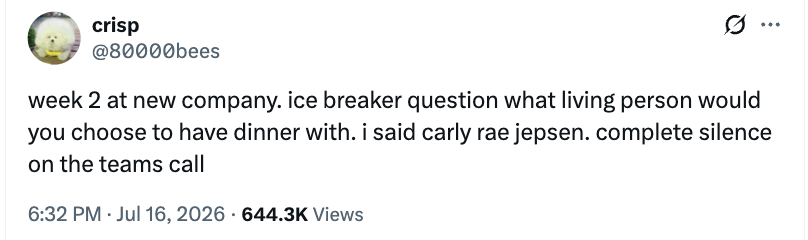
The hot-or-nots going into this weekend:
HOT:
A side of fries for the table
Three-person group chats
Rain-checking (but then actually picking a new date for the event)
NOT:
New York being so up that the universe gave us a collapsing building, Legionnaire’s disease, wildfire smoke, and explosive diarrhea in our lettuce and raspberries
The number of communities on Threads (not enough!!)
Sandal blisters in exactly the wrong place
That’s all for now – I’ll see you next week!