


This is a SPECIAL EDITION of Group Chat Correspondent :) You can find the more recent typical send here.
Just a reminder: every Tuesday and Friday, I’ll be in your inbox with the latest in politics, tech & social media, culture, and other relevant topics – and I’ll share some notes and tips on what I’m keeping my eye on.
ALSO want to do a super fun, super cool rapid interview for this newsletter like the one below??? Reply to this email or hit the button below. Tips, thoughts, concerns, good jokes, bad jokes, ☕️, etc?
And finally, if you enjoy this newsletter and want to share it with your network (and/or your chronically online friends), or buy me a matcha, that would be so appreciated 🙏

Like everyone I know, I’ve been watching Love Story with increasing pangs of guilt. Personally, as someone born and raised in NYC in the late 90s, who was raised with my parents recounting how they paid for this expensive photography session to get pictures of their baby in the park, and then John-John’s plane went missing, and absolutely nobody could focus on anything else, I am stuck between the guilt I know I should feel watching these real people’s lives and horrible, sudden passing and the fact that I was not a sentient being for any of this, so none of it actually seems real. (One silver lining: I’m hype to see CBK’s fave, C.O. Bigelow, getting love again, and I will not feel bad about that!).
And I, like many, was struck by the resemblance between the ethos of JFK Jr.’s George magazine, which was meant to blend politics and culture such that non-politicos could suddenly realize that pop culture had a lot more to do with the ballot box (and vice versa) than elites may have them believe, and just about every pitch deck that Democratic organizations have produced since the 2024 election. George’s tagline was “not just politics as usual,” nodding to its cultural reframe of electoral politics – branding that would be right at home on any of the dozens of Substacks from political thought leaders that have popped up over the last year.
Another similarity, perhaps, to Dems figuring out how to do new media here in 2026: back in the late 90s, George magazine was a bit (or a lot) of a hot mess. Before JFK Jr’s passing, leadership was completely fractured, and, in the sources I’ve read, it seems like the fact that the magazine tried to span “two worlds,” while being headed by a public figure, made it difficult for revenue teams to work with. It suffered from a too-many-buckets problem (which is hilarious to think about today, when I imagine most revenue teams would do anything for a product like this).
Despite the struggles, I think many of us can’t stop thinking about how JFK Jr. seemed to have had a remarkably prescient idea almost 30 years too soon – and what lessons we can take from it, especially given that the media landscape now is practically unrecognizable as compared to the era when George flopped.
First, an elephant (or a donkey) in the room: I find the now-iconic first cover of George – which featured superstar model Cindy Crawford (which, I think, is meant to conjure this) – to be insanely awkward. I can’t fully verbalize it except to say that when I saw the launch cover, it seemed to prophesize the tension and stilted awkwardness that would later plague the publication.
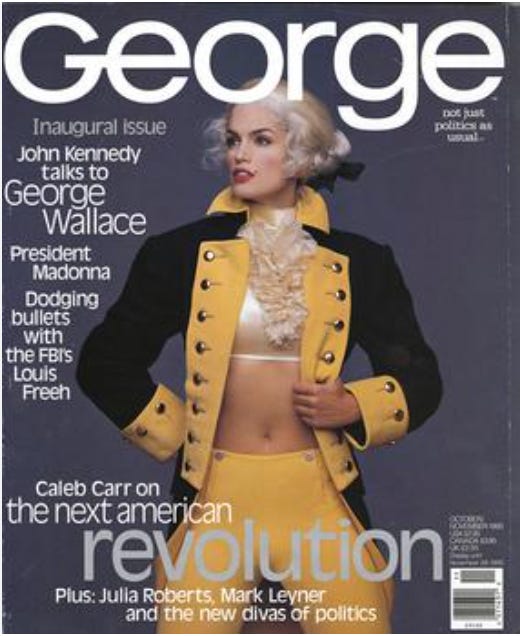
I wanted to do my due diligence, however, and ensure that this wasn’t just a product of my Gen Z brain. So, these are, I believe, all covers from best-selling US magazines from August or September 1995 that should have been on stands the same time that George’s first edition was.
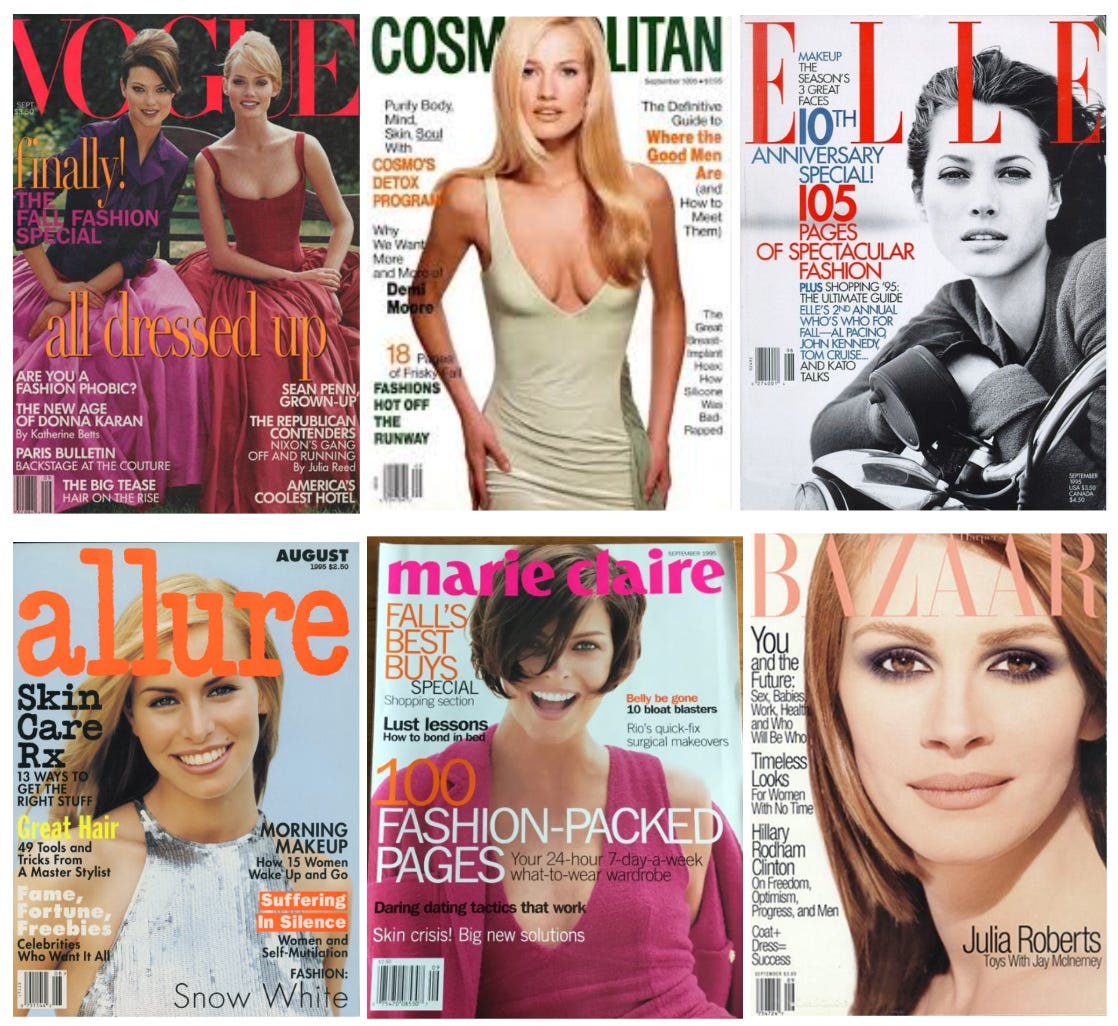
My final analysis: these other covers contextualize George’s first issue more… but something about it just feels fundamentally uncomfortable with itself. Maybe this is hindsight speaking, but you can feel the nerves through the subheadings.
Which is ironic, because George magazine really did have the who’s who between its pages, from Madeline Albright to Madonna (to Harrison Ford, whose cover I actually think is fun). And again, imagining an analogue in 2026 to the first edition of George, which had the Cindy Crawford cover, a Q&A with George Wallace, a piece by Chris Matthews, and a feature on Julia Roberts: that would be something like Jack Schlossberg putting together a magazine with Kendall Jenner on the cover, a Q&A with Liz Cheney, a piece by Jake Tapper, and a feature on Margot Robbie. (Sorry if you don’t agree with those analogies – this is a fun mental exercise if you also really want to see how much culture has splintered since the 90s).
All that to say, I can imagine every media organization – certainly, Vogue, at least – salivating over this. Also, it would probably never happen, given that any “public” figure’s risk tolerance for attaching their brand to anything political in any meaningful way (I don’t mean a selfie two weeks before an election) is so damn low.
So, all we’re left with is a fascinating, fairly ghostly puzzle: a 25-year-defunct politics x culture magazine spearheaded by a Kennedy with lines like “the new divas of politics” that would have killed today on TikTok. A modern new media ecosystem suddenly desperate to do the same thing, but in a splintered, fraught time when it seems even more impossible than it was for beleaguered George back in its day.
What happens now (besides everyone rushing to collect old George editions)? Well, the obvious answer is that someone is going to bring the actual George magazine back, if I had to guess. Perhaps the results of the NY-12 congressional race will also shed some further light. But what I’m really curious to see is whether or not someone can take the lessons of the past and the present – the alleged awkwardness of spanning two separate content buckets, the revenue problems it might implicate, the trouble with developing a cohesive identity and brand, etc. – and build a politics x culture publication that is resilient and self-actualized enough to withstand the tides of American attention that have sunk so many others.